
How I help
The work takes three forms, but the thread through all of it is the same: getting you from ambiguity to action with confidence.
Strategy
Nonprofits don't need more technology. They need the right technology, pointed at the mission. Strategy work answers the big directional questions: what systems you actually need, what your data should be doing for you, what AI means for your organization, and in what order to move. The deliverable isn't a PowerPoint presentation. It's a decision your leadership team is confident in, and a roadmap you can execute at your size and budget.
This is the work when you're asking: Should we replace our CRM? What should we make of AI? We have data, now what?
What's included:
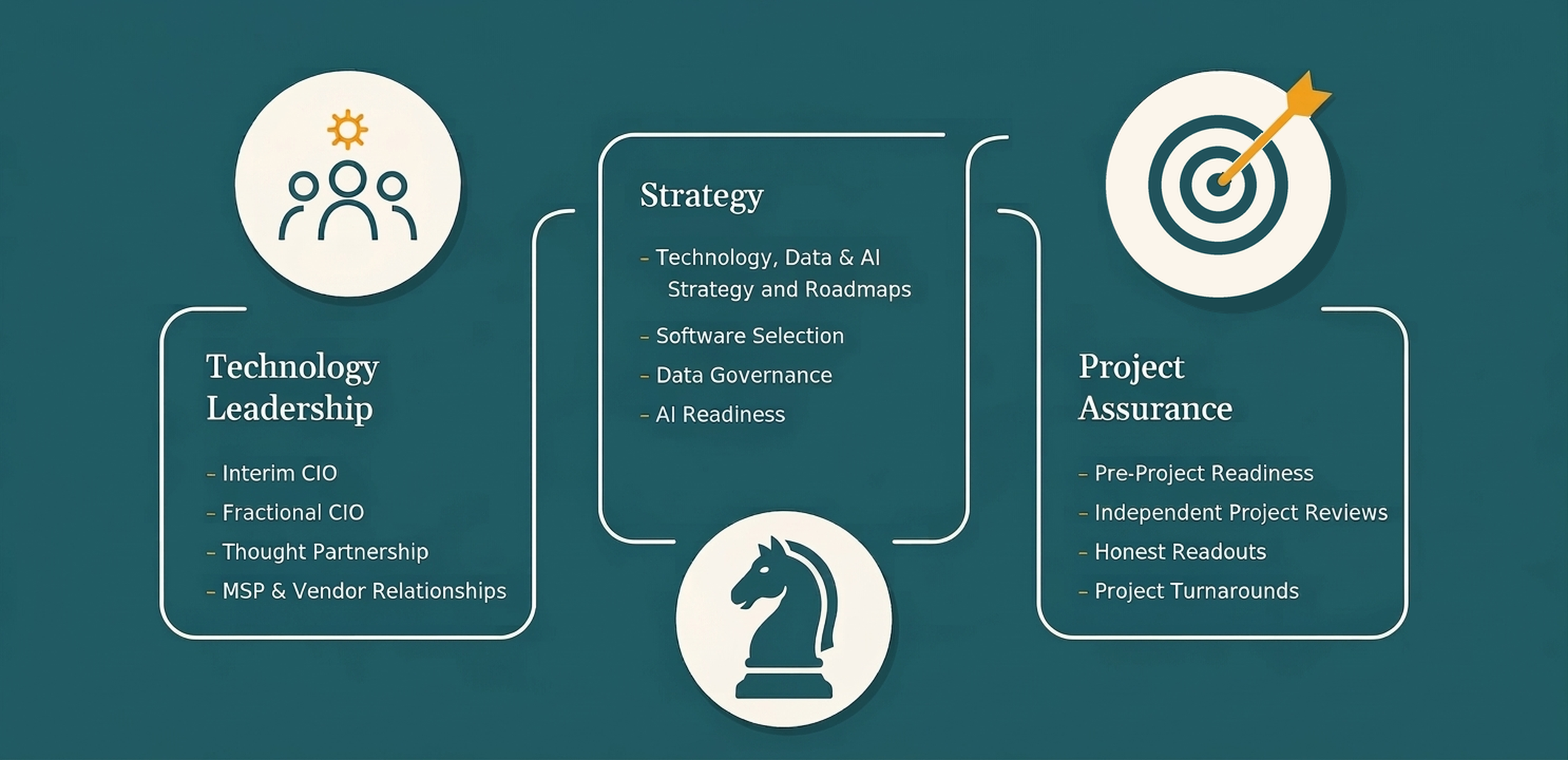
Technology, data, and AI strategy and roadmaps
Software selections, scoped to fit and run with an independent, implementation-aware mindset
Data governance that's right-sized, not heavyweight
AI readiness: an honest assessment of where AI fits your mission and your team
FAQ
How long does a strategy engagement take? Most run 8 to 16 weeks depending on scope. Long enough to be rigorous, short enough that the world hasn't changed by the time we finish.
Do you implement, too? No. I am not a systems integrator, and that's deliberate. I have no software to sell and no vendor or implementation partner pays me anything, so my only incentive is the right answer for you. When it's time to build, I'll help you find the right implementation partner and stay on in an assurance or leadership role if you want the continuity.
We're small. Is this overkill? Strategy scales down. An appropriately scoped engagement for a small organization can be a few focused weeks, not a season.
A Nature and Education Center
Technology Strategy and Roadmap, followed by CRM Selection and Project Assurance
Situation. A smaller organization with an education center and a wildlife hospital at its heart needed a real technology strategy. The systems behind fundraising, guest management, volunteer management, finance, the website, and the hospital itself had grown up piecemeal, and the organization wasn't happy with how everything was working together.
The work. We built the strategy and roadmap and took it to the senior leadership team and the board. The roadmap covered the essentials: better fundraising and guest management systems, an upgraded financial system, a redesigned website, and a wildlife management system for the hospital, plus a lightweight governance model an organization this size could actually run. When the strategy turned into projects, we selected a new CRM together and advised the team through the implementation that followed.
Outcome. Leadership and the board aligned on the goals, and the board funded the plan. The systems got built. And the organization came out the other side better able to put technology to work for its mission.
Project Assurance
Plenty of consultants will tell you your project is going to fail. That's not me. Your project is going to succeed. The question is how hard the road gets before it does. Project Assurance is an objective set of eyes on the work: before the project starts, while it's running, or after it's gone red. I've spent three decades inside nonprofit technology projects, and most of what makes them hard is visible early, if someone independent is looking.
This is the work when you're saying: Our critical project is in red status. Or better: we're about to start something big and we want it set up to succeed.
What's included:
Pre-project readiness: scope, governance, staffing, and the business side of the statement of work shaped before anything is signed
Independent project reviews, monthly or quarterly, through the life of the project
Honest readouts your board can trust
Turnaround leadership when a project has gone off course
FAQ
Whose side are you on? Yours. But here is what I have learned over time: these projects succeed when the client-vendor relationship is a partnership, and they fail when it turns adversarial. So my job isn't to catch your vendor doing something wrong. It's to keep the relationship honest, the expectations clear, and both sides working the same problem. An independent voice in the room makes that easier, not harder.
Is a review going to slow the project down? No. A comprehensive review takes days, not weeks. A periodic review takes a day. The projects that actually get slowed down are the ones where problems stay hidden until they're expensive.
When should assurance start? Before the statement of work is signed. The most expensive problems in any project are the ones baked into the SOW: vague scope, missing client responsibilities, optimistic timelines. I help you shape the business side of that document before it becomes binding. (I'm not a lawyer, and your counsel should always review the legal terms.)
A National Conservation Nonprofit
Technology Strategy and Roadmap, followed by Project Assurance
Situation. A national conservation nonprofit was running its CRM and financial systems on a custom platform that had been in place since the 1990s. Decades of accumulated technology debt, and nearly every part of the operation touched it.
The work. We started with an IT strategy and roadmap built on clear pillars: standardize on the Microsoft toolset, replace the CRM and financial systems, rebuild the website, replace the conservation systems, strengthen the information security posture, and build a data analytics platform. Then came the big one. The organization implemented Microsoft Dynamics 365, Business Central, and Customer Insights & Journeys, with Boomi as the middleware connecting CRM, finance, the new website, and a custom event management system, plus a data lake serving core operational reporting. My role was project advisor: an objective set of eyes on the work, and a steady hand helping the organization build a productive working partnership with their implementation partner, RSM.
Outcome. The systems went live last summer. The organization is absorbing a lot of new technology at once, and it's already planning the platform's next phase: extending it into other areas of the business, starting with conservation.
Technology Leadership
Sometimes the answer isn't a strategy or a project. It's a person. Technology Leadership is me stepping in where the gap is: as your interim CIO while you search, as a fractional CIO when you need senior judgment but not a full-time hire, or as a thinking partner standing behind the technology leader you already have. The goal is always the same, and it isn't to stay forever. It's to leave your technology function stronger than I found it.
This is the work when you're saying: Our IT function isn't partnering with the business the way we need. Our CIO just left. Our technology leader is good and wants a thinking partner. Our MSP isn't delivering.
What's included:
Interim CIO leadership during a search or a transition
Fractional CIO support, senior judgment on your side of the table
Thought partnership and coaching for sitting technology leaders
MSP and vendor relationship resets: clear expectations, honest scorecards, and service that matches the invoice
Helping you select and onboard your next technology leader
FAQ
How much time does fractional actually mean? Typically 4 to 12 hours a week, shaped around your rhythms: leadership meetings, board prep, vendor calls, and a standing hour with your team. Enough presence to matter, not enough to become overhead.
We have an IT director. Won't this step on their toes? Done right, it's the opposite. The arrangement works when it's framed honestly: I'm there as a thinking partner, to make a good leader better and their job easier, not to audition for their chair.
How long do interim engagements run? Most run 3 to 12 months, long enough to stabilize the function, fix what's urgent, and help you hire well. I'm not a candidate for the permanent seat, which means my advice about the function's future is actually independent.
A Large Healthcare Nonprofit
Interim CIO
Situation. The organization came to me for a focused CRM assessment. Its fundraising platform wasn't performing, and everyone knew a replacement was coming. But the selection had run into trouble: the proposed direction was a poor fit for a nonprofit, the staff knew it, and the disagreement was consuming more and more of the leadership team's attention. The organization decided a change was needed and asked me to step in as interim CIO and a full member of the executive leadership team.
The work. I led a technology team of roughly 100 people, keeping the critical infrastructure, security, and application development projects moving and completing them. With the team, we built an application roadmap to guide what came next. We got the software selection back on track. And when the time came, I worked with the recruiter to hire my successor, then helped onboard him.
Outcome. By the time the new CIO arrived, the selection was set up properly and ready to run. He went on to implement the new CRM and its related systems successfully, and he inherited a function that was stable, staffed, and pointed in the right direction.
Sitting with a technology question you can't quite get your arms around?
I'd genuinely like to hear about it. The easiest next step is a conversation, and it costs nothing but 30 minutes.